
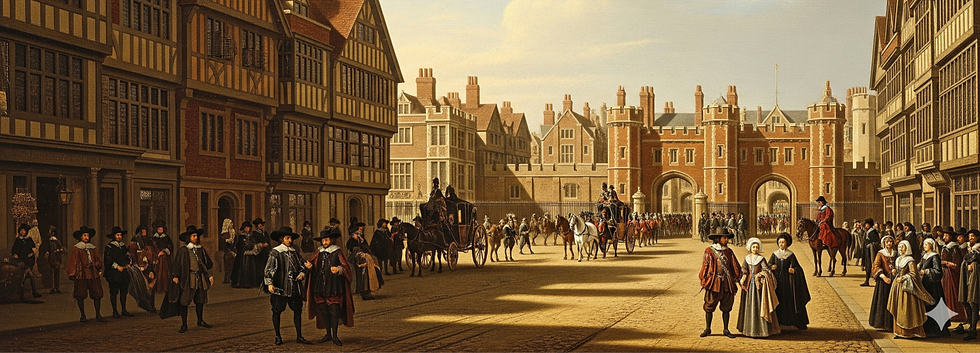
STUART WESTMINSTER
The Stuart era of just over 100 years saw Westminster continue its growth, surviving civil war, plague, and fire to emerge as a more developed administrative and social heart of the kingdom.
Key Changes in Westminster:
Civil War and Interregnum: Westminster was at the heart of the English Civil War (1642-1651). The execution of Charles I outside Banqueting House in Whitehall in 1649 was a monumental event. During the Interregnum (1649-1660) under the Commonwealth and Protectorate, the monarchy was abolished and Whitehall was repurposed.
Palace of Whitehall Destruction: The vast and sprawling Palace of Whitehall, the main royal residence, was almost entirely destroyed by fire in 1698. This event dramatically reshaped the area, clearing space for future developments and shifting the focus of royal residence eventually towards St. James's Palace and later Buckingham House.
Early Urban Planning and Development: The early 17th century saw the creation of Covent Garden by Inigo Jones, introducing formal squares and classical architecture. This marked a shift towards more planned urban development that would eventually spread across Westminster. New fashionable residential areas began to emerge beyond the immediate vicinity of the palace, such as St. James's and areas around what would become Piccadilly.
Life in Stuart Westminster: A period of immense change. The air was thick with political intrigue, particularly around Parliament. Coffee houses began to emerge, becoming centres for gossip and political debate. Life was still hard for many, but the nobility and gentry enjoyed lavish entertainment, from plays to masques. The Great Plague of 1665 and the Great Fire of London in 1666 (though it largely stopped short of Westminster) left deep scars and prompted new approaches to urban living.