
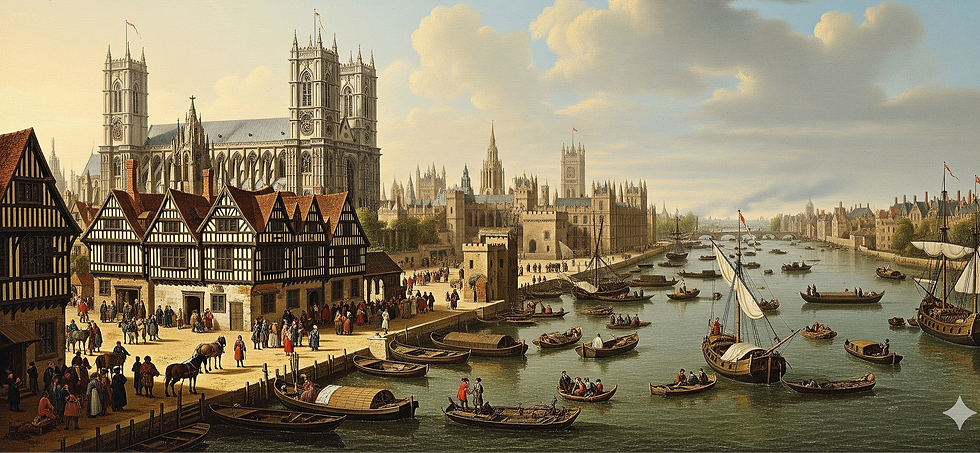
TUDOR WESTMINSTER
During the Tudor era, Westminster was a distinct entity, separated from the City of London by fields and connected primarily by the Strand. It was the seat of royal and ecclesiastical power, dominated by the enormous Abbey and the sprawling Palace of Westminster.
Key Changes in Westminster:
Expansion of the Court and Nobility: As the royal court centralised in Westminster, noblemen and courtiers began to build grand houses along the Thames and the Strand, creating a fashionable residential area around the monarch.
Dissolution of the Monasteries: This seismic event under Henry VIII saw the vast wealth and lands of Westminster Abbey seized by the Crown. While the Abbey itself survived as a cathedral, its power was diminished, and other monastic institutions in the area were dissolved, leading to significant structural and social changes. This event would have sent shockwaves through the local community, affecting many who relied on the monastery for employment or charity.
Rise of Henry VIII and the Royal Court: With Henry VIII's move from the Palace of Westminster to the newly acquired Whitehall Palace in the 1530s, Westminster became even more firmly established as the primary royal residence and administrative centre. But, while Westminster was a primary base, the entire court was semi-nomadic, moving between royal palaces like Hampton Court, Greenwich, and Richmond. However, for key events like Parliament, coronations, and state occasions, Westminster was crucial.
Life in Tudor Westminster: Life was dictated by the rhythm of the court and the church. The streets would have been a mix of grand processions, market traders, pilgrims, and servants. Disease was rife amongst all class of Tudors, sanitation rudimentary, and social hierarchy strictly observed. The soundscape would have been a mixture of bells, street criers, and the hooves of horses, all set against the backdrop of the traditional timber framed Tudor buildings.